What Contractors Pay Business Coaches: Fees, Retainers and the Math Behind Them
The most common coaching fee in the trades sounds like a question. The coach says "so it would be around two thousand a month" with the pitch rising at the end, hears silence, and adds "or whatever you think is fair." That sentence costs several hundred dollars a month for the life of the engagement, and it repeats on every call until something changes it. This guide is the something: what contractors actually pay business coaches, the three fee structures that hold up, the arithmetic that produces your number, and how to say it out loud.
What contractors are already paying for advice
Start with what the owner of a $3 million HVAC company already spends on people who tell him what to do. His outside accountant runs $400 to $1,200 a month depending on what is bundled. His field-service software costs $300 to $1,500 a month and comes with a customer success rep who gives business advice free with the subscription. If he belongs to a peer group or best-practices network, that is anywhere from a few hundred dollars a month to five figures a year, plus travel. If he is in a franchise or a buying group, there is a royalty or a membership on top.
So the owner is not deciding whether to pay for advice. He is deciding whether yours is worth more than the advice he is already paying for and mostly ignoring. That changes the pricing question. The competition is a monthly software bill he never questions, and that is the bar.
The three structures that work, and the one that does not
Monthly retainer. A fixed fee for a defined cadence, usually two to four sessions a month plus access between them, for a defined term of six or twelve months. This is the structure most solo coaches in the trades should default to. It matches how the owner already pays for everything else in his business, it makes cash flow predictable, and it makes renewal a conversation rather than a re-sale.
Engagement fee. A fixed price for a fixed outcome in a fixed window: reprice the maintenance agreement base in sixty days, build the flat-rate book in ninety, get the callback rate under a target by season's end. Higher price per month, cleaner scope, and a natural door into a retainer once the project lands.
Retainer plus performance. A base retainer with a bonus tied to a measured number: gross margin, agreement count, average ticket. Powerful with owners who have clean books, and dangerous with owners who do not, because you will spend the engagement arguing about the number instead of moving it. Use it only in year two with a client whose reporting you trust.
Hourly does not work. Hourly pricing invites the owner to ration you, punishes you for getting faster, and turns every call into a meter. The only coaches who charge hourly in this market are the ones who have not yet calculated what a month of their attention is worth.
The ranges, with the caveat that matters
Published directories put general business coaching between roughly $500 and $5,000 a month, which is a wide enough range to be useless. In the trades, for a solo coach serving four to eight owners of $1.5 million to $10 million companies, the working retainer range runs about $1,500 to $3,500 a month per client, with engagement fees priced above the equivalent monthly rate and coaches with a track record in a specific trade pushing higher.
The caveat: those are other people's numbers. Your number comes from your inputs, and a coach who prices off a survey instead of a calculation will end up at the bottom of the range because the bottom is where doubt lives.
The arithmetic that produces your fee
Four inputs, one division.
- Annual income target. What you need this practice to pay you this year, before tax. Be specific. "Replace my salary" is a number; write it down.
- Client load. How many owners you can serve properly at the same time. For a solo coach doing two to four sessions a month each, that is usually four to eight. Ten is possible with systems. Fifteen is a job.
- Monthly overhead. Software, insurance, phone, the accountant, a little marketing. For most solo practices, $300 to $1,000 a month.
- Hours per client per month. Session time plus preparation plus between-call contact. Four hours is typical for a two-session cadence; eight for weekly.
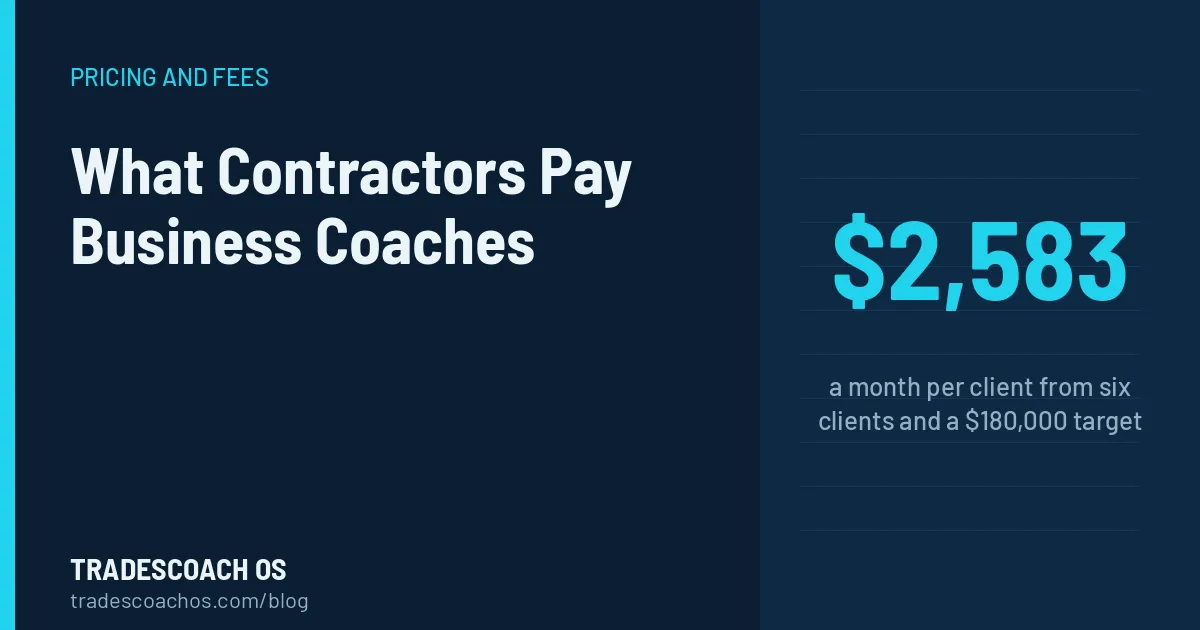
Then: (income target plus twelve months of overhead) divided by twelve, divided by client count, equals the monthly fee. Six clients, $180,000 target, $500 overhead, four hours each produces $2,583 a month per client and about $646 per delivered hour. Change any input and the fee moves; that is the tool doing its job. The free fee calculator runs this in about thirty seconds and asks for nothing, not even an email.
Why the owner's math makes your fee small
Put your fee next to one leak. A $3 million HVAC company with a 6 percent callback rate is redoing roughly $180,000 of work a year for free, before the second truck roll and the customer it loses. Getting that rate to 3 percent is worth around $90,000, and it is one of five leaks a coach works on in year one. A $2,500 retainer is $30,000 a year. The question in front of the owner is whether he would like to keep some of that money.
That is the conversation to have when the fee lands, and it only works if you know his numbers. The discovery call exists to get them. Ask for callback rate, agreement count, average ticket, and service-to-install mix before you ever say a price, and the price will sound like the smallest number in the room.
How to say the number out loud
Three rules, all of them mechanical.
First, say the fee and the cadence in one breath, then stop talking. "It is $2,500 a month, we meet twice a month, and the first ninety days are mapped before we start." Then silence. The silence is where the owner does the math from the previous section. Filling it with "or whatever you think is fair" deletes the math.
Second, anchor before you state. The engagement fee or the twelve-month total goes first, the monthly figure second. "Over the year that is thirty thousand, which is $2,500 a month" lands differently from the reverse.
Third, have the three pushback lines ready before you need them. "That is more than I expected to pay" usually means "show me the return"; answer with his callback number. "I need to think about it" usually means "I need to justify it to my wife or my partner"; answer by offering to run the numbers with both of them on the call. "Can we start smaller" usually means "I am not sure you will show up"; answer with the ninety-day map and the guarantee conditions, in writing, that night.
Raising the rate later
The second-year price is set by the first-year results. Track two or three numbers from the first session onward, put them in the renewal conversation, and raise the retainer with the renewal. A coach who documents that the maintenance base went from 380 agreements to 610 does not negotiate the increase; the owner does the arithmetic for him. What kills rate increases is the absence of a number, which is why the tracking starts on day one and not at renewal.
Frequently asked questions
How much should a new coach charge a contractor?
Whatever the arithmetic produces from your income target, client load, overhead and hours. For most new solo coaches that lands between $1,500 and $3,500 a month. Price from the calculation, not from nervousness about being new; the owner cannot see your tenure, only your questions.
Should I charge hourly to start?
No. Hourly pricing rations your access, penalizes speed and turns every call into a meter. A monthly retainer for a defined cadence is how the owner already pays for everything else in his business.
What do HVAC business coaches charge?
The same structures apply, and HVAC specifically supports the top of the range because the profit leaks are large and measurable: maintenance agreement pricing, callback rate, and the service-to-install mix. A coach who can name those numbers on the first call is rarely asked to discount.
Is a performance bonus a good idea?
Only with a client whose books you trust, and usually not in year one. A bonus tied to a number the owner cannot report cleanly turns the engagement into an argument about measurement.
Jim Cosmas spent 45 years in the home service trades before founding TradesCoach OS. The Coach's Toolbelt is his $97 kit of the working parts of a contractor-coaching practice, including the pricing calculator, the pricing-delivery scripts, the raise-your-rate playbook and the three contract types, with a client-in-45-days guarantee. Run your own number tonight.
